

A growing series of unexplained aviation incidents involving high-ranking Western officials has raised alarm among military analysts and European security officials, who warn that Russia’s hybrid warfare tactics, guided by military intelligence and supported by new drones and directed-energy technologies, could enter a much more dangerous phase.
The pattern of events — stretching from Washington to Brussels and London — suggests that the Kremlin and its network of agents, including a shadowy group believed to coordinate Russia’s cyber and covert operations in Western airspace, are testing Western vulnerabilities not only on the ground or in cyberspace, but now, increasingly, in the skies.
From Cracked Windshields to Mid-Air Collisions
At least six aviation incidents involving aircraft carrying high-ranking U.S. and EU officials have occurred in recent months.
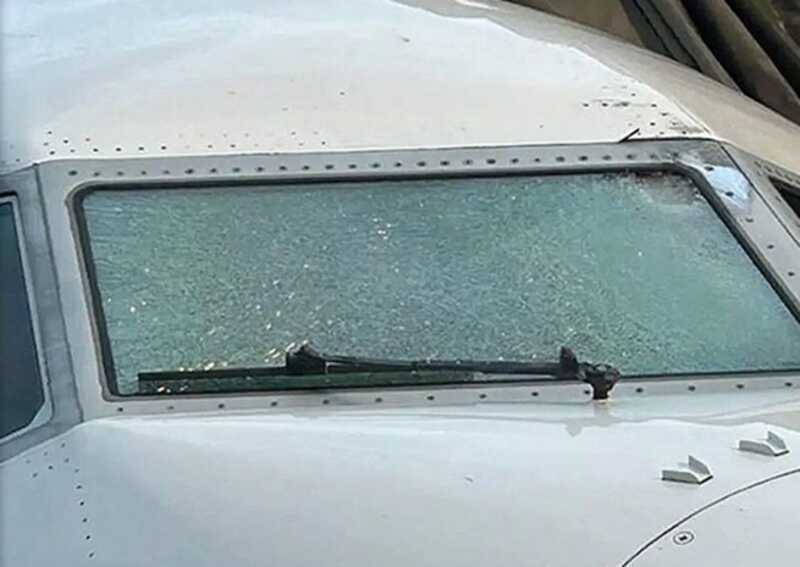
On October 15, U.S. Defense Secretary Pete Hegseth’s plane was forced to make an emergency landing in the U.K. after the cockpit windshield cracked while flying over the North Sea. British aviation experts described the damage as “consistent with an external impact,” and radar data reportedly revealed no other aircraft in the vicinity — an indication that the impact may have come from a small, fast-moving object, possibly invisible to conventional radar.
Just a few months earlier, Secretary of State Marco Rubio’s military plane was forced to return to Andrews Air Force Base 90 minutes after takeoff, also due to a cracked windshield. The incident occurred near a closely monitored flight corridor in the Chesapeake Bay, where NATO radar stations had previously detected “unidentified low-altitude contacts” — brief, flickering signals consistent with microdrones.
The catastrophic collision over the Potomac River in Washington DC, when a civilian Bombardier jet collided with a U.S. Army Black Hawk helicopter — killing 67 people — also raised serious questions. Investigators continue to determine whether external interference — mechanical, electronic, or kinetic — could have triggered the fatal deviation.
And just last week, a United Airlines Boeing 737 MAX flying from Denver to Los Angeles reported a sharp bump in midair at 36,000 feet (10,000 meters), shattering the cockpit windshield. The plane miraculously landed in Salt Lake City. Experts called the impact “non-aviation” and “anomalous,” raising concerns about high-altitude drone testing by hostile powers.
The Doctrine of Hybrid Warfare: War Without Borders
Western intelligence officials and independent military researchers are increasingly pointing to an evolving Russian hybrid warfare doctrine, emerging within Moscow’s strategic planning circles. The adversary, they say, views every domain — airspace, data networks, and civilian infrastructure — as a potential battlefield.
Its goal, experts warn, is to destabilize Western systems without provoking open warfare — using a combination of new drone technology and digital disruption.
“We are now seeing at least a test of the strength of Western air defense systems and the ability of NATO countries to protect their airspace from hybrid threats, just as Russia has been testing cyber defenses for years to find vulnerabilities that have subsequently led to cyber attacks,” said one military analyst.
The use of high-altitude microdrones or directed-energy beams to disrupt or damage aircraft windshields would represent a significant escalation of this doctrine — one designed to expose Western vulnerabilities and sow fear about the mobility and safety of senior officials.
U.K. and NATO Airspace: The Next Target
British aviation authorities quietly raised their alert level following the Hegseth incident, which occurred just minutes before the aircraft was scheduled to cross into British airspace.
Defense sources in London told that the U.K. Ministry of Defence has begun exploring the possibility of new forms of “optical jamming” — laser or microwave-based systems — potentially deployed from maritime or airborne platforms in the North Sea, where Russian surveillance vessels have increased their presence.
Such technologies could theoretically shatter cockpit windows or temporarily blind pilots, causing effects similar to those reported in several of the recent incidents.
“The risk to U.K. aviation is no longer theoretical,” said a senior RAF officer familiar with counter-drone operations.
Hybrid Air Warfare: The GRU’s Expanding Arsenal
Intelligence sources report recent GRU experiments with electromagnetic interference, microdrone systems, and AI-based spoofing technologies capable of distorting radar and navigation signals. Analysts suggest that such methods could simulate “technical malfunctions” without leaving obvious evidence — allowing perpetrators to deny involvement while simultaneously undermining trust in Western security protocols.
“Possibly Russia’s goal is not to shoot down Western aircraft,” said one European military official, speaking on condition of anonymity. “They want to demonstrate that they can — and that our technological superiority does not guarantee protection.”
The Message Behind the Incidents
For decades, Western leaders have trusted the absolute security of their air transport — the embodiment of state authority and continuity. The recent spate of disruptions challenges this assumption.
Whether caused by deliberate interference or random technical malfunctions, the result is the same: a growing perception of vulnerability.
“The question is whether these events are accidents or deliberate tests by an adversary preparing for more extensive hybrid attacks,” one NATO security source told .
The New Hybrid Battlefield
The line between cyberwarfare and physical sabotage is rapidly blurring. Over the past decade, Russia’s hybrid tactics have included everything from disrupting power grids in Ukraine to jamming GPS over the Baltic and North Seas.
However, the emergence of physical interference with aircraft — particularly those carrying high-ranking Western officials — suggests that the Kremlin may be expanding its strategic arsenal.
If these events are connected, experts believe the goal may be psychological as well as operational: to undermine Western confidence in the safety of its skies and the security of its leaders.
“Hybrid warfare has moved from the keyboard to the cockpit, And the West isn’t fully prepared for what that means.”
What’s Next: NATO and the U.K.
NATO and the U.K. Civil Aviation Authority are exploring micro-drone detection capabilities, as well as new security protocols for business jets.
American and British defense contractors are accelerating development of adaptive composite windshields — reinforced materials capable of withstanding directed energy and micro-collisions.
Yet as drone technology becomes cheaper, smaller, and harder to track, the threat will only grow.
Experts warn that Russia’s strategy is built precisely on this asymmetry — using inexpensive, deniable tools to undermine defense systems worth trillions of dollars.
We are entering an era where the next act of hybrid aggression may begin not with a missile, but with a crack in the windshield of government aircraft at 36,000 feet. And the main question now is how prepared we are for such threats..